
This beautiful long exposure travel photo was taken at Avoca beach during an attempted camping trip a few hours north of Sydney in the Central Coast area!
I say ‘attempted’ because we drove all the way there to find that there was literally zero places to camp! (It was a public holiday..)
Either way, we still got to see the incredible Australian night sky, some shooting stars and a few satellites – something not really possible in Sydney!
I think this shot could be made better if the exposure was shorter and I bumped up to ISO 200 to the fact that the stars are starting to ‘trail’ – not to be confused with a blurry shot!
The fear became real to me recently, when I heard the sad news that my Nan had died. Losing someone you love is never easy, but losing someone while away, made me feel helpless and guilty. I am reassured that my Nan died in her sleep, in her own bed and she never had to go to hospital or into a care home. This makes me content and glad that she died with dignity and had it her way.
When I found out I’d lost my Nan, I desperately wanted to call her and tell her how much I love her and to say bye one last time. I regretted not calling her more and not seeing her enough on my last visit home.
I wished I had a crystal ball so I could have foreseen this and chosen to have stayed at home, rather than go travelling again. But then I knew that’s not what she would have wanted. I’m glad I can say I was a good granddaughter, we both liked and loved each other and enjoyed each others company. I know that every meeting and conversation was meaningful and meant a lot to both of us. I am grateful for that.
Stu and I made the easy decision to leave Thailand and go back for my Nan’s funeral. I wish I could see my Nan for a hug and a chat while we’re back, but of course that’s not possible.
Losing someone I love while I’m travelling is still a fear of mine.
If you had this fear would you still leave? Would you put off a trip of a life time because someone might die, or would you go and live your life and what will be will be?
Have you ever lost someone you love while you’re away travelling? How did it make you feel?
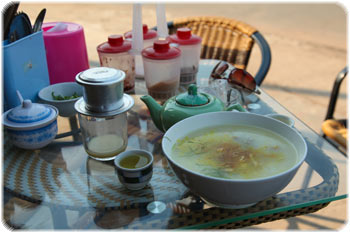
Vietnamese breakfast of ‘Cháo’ – rice soup with chicken (I think) and coffee!
We knew we had a long ride ahead of us today as we planned to backtrack all the way to Tat Lo, probably the longest leg of our journey on the Bolaven Plateau. So that meant an early start! We rode out to the main market in Attapeu fist thing to grab some baguettes and rambutans, much to the amusement of the locals who looked like they’d never seen a falang before!
I grabbed a quick typical Vietnamese breakfast of ‘Cháo’, a hearty mix of rice and chicken and a cheeky Vietnamese Ca Phe Sua Nong (strong short Vietnamese coffee with a slug of condensed milk!) and a complimentary pot of tea to kick start the day. Instantly needing a wee, we set off back towards Sekong just before 9:30am, still relatively cool and clear – perfect riding conditions!
It was good to take in the sights and ride a bit slower today as we were racing against the clock on our way to Attepeu. The road between Attapeu and Sekong is stunning. We passed rivers and streams, countless banana groves, and even more stilted shacks with smiling faces waving back at us.
Creatures of habit, we couldn’t help but stop in Sekong for another refreshing sugar cane juice and catch up with our new parrot friend and a rest-bite from the ever-rising sun.
Bad roads in the Sekong area
Just outside Sekong we hit some road maintainance and loads of loose gravel and shingles which slowed us down a bit.
Exploring villages away from the main road
We ventured from the main road, 1. To explore some of the villages away from the road and 2. For a wee. Now these villages were truly off the beaten track. We were a hit with the locals and some of the children seemed to be quite fascinated with my blonde arm hair!
Barbecued bananas
We pushed on another 50km or so to Tha Taeng for some lunch, an arse break and some barbecued bananas on sticks! Tha Taeng is up at about 900m so it’s a lot cooler than sweat box Sekong and Attapeu, and it’s a perfect lunch spot before heading north to Tat Lo or back south to Paksong.
Our GT Rider map said the road north to Beng and Tat Lo was unsealed. Preparing for another bumpy ride we were glad to find that it’s recently been tarmacked all the way to Beng. This 20km stretch was probably the most beautiful we’d seen on the Bolaven Plateau, with glorious mountain views over rice paddies, rickety farmer houses and piles and piles of coffee berries drying in the sun.
We got a bit lost on the way to Tat Lo and almost stayed in the wrong village completely! But we got there eventually before dark, checked into Sipaseth Guesthouse overlooking the Tat Hang waterfall (quite expensive at 80,000 Kip, hot water), grabbed some Beer Lao’s and watched the sunset by the river.
With our Laos visa running out and our flights to Thailand booked back to Chiang Mai, we begrudgingly packed up and set off from Tat Lo back to Pakse. In Tat Lo we picked up a leaflet about a Katu Textile Village, and decided to head there when we came off the plateau on the way back to Pakse. We saw signs for ‘FRESH GROUND COFFEE’ a few kilometres away from the village and pulled in. It would be rude not to!
We were pleasantly surprised to find out that as well as producing amazing textiles, they also produce their own home-grown coffee. And we arrived just as Mr Vieng and his wife were about to start roasting some beans!
This is a process we missed out on during our tour with Koffie, and something I had no idea about previously. First we pounded the beans in a huge pestle and mortar that Mr Vieng had made, removing the fine skin from the beans. It’s much harder than it looks, the wooden pounder was pretty heavy! Mr Vieng seemed amused with our lack of output, and quickly took over!
Dried beans ready for roasting
Then the skins and beans had to be separated. Using a woven sort of tray that I’ve seen used before for separating rice from its husk. Mr Vieng’s wife expertly separated the two. The beans had been drying out for 10 days beforehand to totally remove any moister from the coffee beans.
At least I gave it a try.
Once we had enough to roast, the trusty coffee roasting wok was produced and placed on the hot coals ready for the beans. Mr Vieng uses absolutely nothing during the roasting process, but he said that other coffee bean growers use sugar or oil to help ‘bulk out’ the beans and bring up the overall weight for more profit. Ultimately meaning lower quality coffee.
When the pan was ready, in went the beans and he began stirring like crazy. Once you put the beans on the heat, you can’t stop until they’re roasted. 15 minutes vigorous stirring later (you should see the size of his forearms), smoke was beginning to rise from the pan and the beans were looking very dark. He took the beans off the heat and poured them back into the woven tray and his wife tossed them again, separating burnt and excess coffee particles from the sweet smelling beans once more.
‘Robusta’ trees
The final process was to pick out the burnt beans by hand and allow to cool. Mr Vieng said he roasts 5-6 Kg of beans per day. He can sell each kilo bag for 25,000 Kip (£1.95), but experiences 10-30% loss in weight from the start process due to burnt beans and loss of moisture and skins. No wonder people add other ingredients to the mix!
Roasting!
To put it in perspective, he said there are 40 cups of coffee per kilo. He said the real profit is the per cup price he sells for 10,000 Kip (80p) to tourists. And I can tell you that first sip of fresh ground and roasted robusta coffee hand-picked from his garden is well worth the 10,000 Kip! So think about the profits that are being made at Starbucks when your sipping on your next latte!
It was truly an eye opening experience seeing the process from berry, to bean, to cup. A very labour intensive process, with little profits for the makers and growers of the Bolaven Plateau’s independent coffee producers.
There’s also the opportunity for a home-stay with Mr Vieng and his wife in their beautiful home, surrounded by lush Robusta trees – Something we would have done if we had time on our Lao visa.
The final stretch into Pakse as the sun was coming down
Buzzing, we set off for the final 60 km back to Pakse. We wish we didn’t have to leave the Bolaven Plateau as it was probably our best Lao experience yet. We could have easily gone further round past Attapeu towards the Vietnamese frontier, and even headed north towards Salavan, spent more time in Tat Lo…
But there’s always next time! 😉
So there it is! A pretty huge article, probably our biggest. I hope you’re still awake and reading this! I hope you enjoyed it as much as we did!
[box] Check out our other Bolaven Plateau related articles if you haven’t already!
The Bolaven Plateau has always conjured thoughts of amazing fresh coffee in Laos’s main coffee growing region, ethnic villages, off the beaten track adventure and wind in our hair excitement!
We’ve been looking forward to Exploring the Bolaven Plateau by Motorbike for months. It’s something we missed out on our last trip to Laos in 2011 during wet-season, as the roads were awful with horrendous landslides and we didn’t have any waterproofs.
Nothing stopping us this time during dry season!
We’ve written a pretty detailed day by day diary account of our 7 day Bolaven Plateau Adventure. Points if you make it all the way through!
Hopefully there’s some helpful information in there about the route and some of the towns around the Bolaven Plateau.
The dream machine!
When we arrived in Pakse we tried to hire a decent motorbike. I wish we could be back on a roaring Royal Enfield, Indiastyle, but budget dictates. So instead we opted for a Suzuki Smash 110cc with a nice little basket on the front!
Check out the info at the bottom of the article before heading out to the Bolaven Plateau.
Coined as ‘The Big Loop’ We rode from Pakse stopping at Paksong via some beautiful waterfalls. Then from Paksong to Attapeu via Tha Taeng and Sekong, then Attapeu to Tat Lo, staying put for a few days in Tat Lo before heading back to Pakse.
Day 1: Pakse to Paksong
One last coffee and a look at the route ahead!
Set off late as per usual, stopping off for one last coffee in the Bolaven Café on the main strip for last minute route checking and photo opportunities!
Stilted shacks and friendly children
As soon as you leave Pakse along Highway 13, you’re thrown back into rural Laos. Wooden stilted shacks, wandering chickens, children playing Takraw, adults coming back from the fields…
Beans drying in the sun
We soon started seeing more and more signs of Bolaven Plateau’s main export – Coffee! We saw countless coffee berry piles drying out in the hot sun along the road. People even grew coffee bushes in their gardens, fenced off from the hungry cows!
We stopped off for our first taste of Bolaven Plateau coffee at a road side shack at a little fair trade place near the sign for E-TU Waterfall. We sampled a short pokey Arabica, mine with sweet condensed milk (in true Lao style!) and Eloise’s black. Washed down with a complimentary tea! The E-Tu waterfall wasn’t in our guide book, and we decided not to go in and to keeping riding on.
The beautiful Tat Yuang waterfall
Tat Yuang waterfall was a few kilometres closer to Paksong. The waterfall is signposted 1 km from the main highway down a bumpy, dirt track. Entrance is 10,000 Kip, not 5,000 as mentioned in the 3 year old Lonely Planet, and 3,000 for the motorbike.
At 40 metres high Tat Yuang waterfall is a beautiful sight – Even in dry season! You can head down onto a wooden walk way for some good shots, or head down to the water. Bust out the swim gear and dive in! You can always swim in the pools at the top of the waterfall, we didn’t but it looked OK!
Cooling off!
We arrived into dusty and relativity low-key Paksong just before dark. There was some sort of washing-up liquid festival going on which was quite bizarre on the main field near the market. We found this Paksong map pretty helpful, showing some guest houses and bike repair places, as well as our pal Koffie’s website, www.paksong.info.
The view from the Savannah Guesthouse
After getting lost for a bit, we rolled into the Savannah Guesthouse at around 6pm; checked into a 80,000 Kip room (Hot shower/TV), washed off the dirt, grabbed some dinner over the road in one of the family run restaurants and turned in ready for an early start tomorrow!
It’s about 50km from Pakse to Paksong, the roads are paved – but there are still a few nasty potholes around so keep an eye out.
Day 2: Paksong and a Coffee Tour!
We’ve heard of a chap called ‘Koffie’ who lives in Paksong – A Dutch expat, coffee lover and connoisseur who runs a coffee shop in town. We called him up and he mentioned he operates 50,000 Kip coffee tours, teaching about the workings of the Bolaven Plateau coffee industry, about the local area, the farmers and everything else coffee related!
The MOST boring dish I’ve ever eaten.
After the healthiest, and probably the most boring breakfast ever of boiled veg and rice, we decided to back track to the Tat Fan Resort, where Koffie has a stall.
A Long day of riding today. We started early and went for morning booster coffee at Koffie’s place. Stopped for Pho and fried noodles and veg at Tha Taeng. At this point we could have either headed further north towards Tat Lo waterfall, but instead decided to blast it to Attapeu via Sekong.
The dusty ‘short cut’ back to Pakse
We had reservations about travelling to Attapeu, as several people we’d spoken too previously mentioned that the town is in the basin of a valley, and regularly gets up to 40+ degrees in dry season.
The village life on the Bolaven plateau is one of its best features. Seeing the smiling faces of the children as they wave at you riding past, it’s a great feeling – and very humbling.
Net fishing in Tat Lo
We saw a couple of boys crash their bike going into a corner too fast over sand. They literally picked themselves up of the red sandy floor, dusted themselves of smiling and laughing, checked their bike over and jumped back on it and rode off – True Lao style!
The ride was incredibly hot today, even at speed on the bike we could feel the sun’s heat on us. We hit some road maintenance a few kilometres outside of Sekong, meaning massive potholes, dust and big rocks.
Sugar cane juice! Soo refreshing!
When we reached Sekong, we quickly stopped at a set of bizarre statues of ethnic villagers. The sun was beating down, so we pulled in for some fresh sugar cane juice, and some interactions for the local wildlife!
Juiced up and cooled down, we pushed on to Attapeu, a good 80km+ from Sekong. The road was spectacular, but we had to go a bit faster than we wanted to beat the setting sun, pushing the Suzuki to a vibration inducing 80kph!
A battle of wits!
The locals living alongside the road come to life as the sun sets and the air cools- Boys run alongside their tyres with sticks, girls and boys play volley ball and boules, adults swing in hammocks enjoying some sticky rice and a Beer Lao.
Frogs anyone?
Throughout the day, the vibe has become ever more Vietnamese. Eventually leading to full Vietnamese signage everywhere you look, with some token Lao language script thrown in.
Timing it perfectly once more and arriving before the sun set over the mountainous plateau, we arrived in Attapeu.
Attapeu is the first main town after the boarder from Vietnam. It feels like Vietnam – The locals drink from the traditional and iconic coffee filter, Com Bo and Pho is on every menu, everything is written in Vietnamese. What little Lao we knew went out the window, our tones or accent falling on Vietnamese tuned ears. We didn’t know whether to speak Lao, Vietnamese or English, we even tried a bit Thai!
Market ninja chicken captor in Attapeu
Our first thoughts were that Attapeu isn’t a tourist friendly place. After watching the sunset with the locals over the river, we drove around for a while to try and find a restaurant with a menu so that we could convey that we wanted something vegan. We were outright refused entry in a couple of places; even one mentioned in our guide book, and we eventually landed at a restaurant run by ‘Mr Touk’ on the bank of the Sekong River for a much needed meal.
Sunset action in Attapeu
We stayed in the Phongsang Guesthouse (60,000 Kip/Hot water, TV), owned by a lovely Vietnamese woman, who seemed genuinely disappointed that we ate Lao food rather than Vietnamese for dinner! We promised to try Vietnamese tomorrow…
Practicalities of Travelling around the Bolaven Plateau by Motorbike
– Road Conditions The main highways around the Bolaven Plateau are in excellent condition, 99% of the time. Potholes and general surface issues can be a problem, as can sudden road works, and dusty unsealed dirt tracks.
– Repairs Every township or village has tyre repair shacks should you get a puncture. If you can get to one, someone will help you out. It seems to be a common occurrence for the locals so try not to panic. Petrol stations are very common, and in the more remote stretches of highway, old style pumps can be found alongside bottle of petrol in case you run out! If in doubt, just top up again if you’re doing a long stretch.
– Safety Other bikes. The Lao don’t race (the majority anyway)! But they’ll double up and ride alongside each other chatting, so give ample overtaking space. Watch out for Hilux and Landcruisers speed-freaks bombing past you, double overtaking a bus and a bike on a bend. On day 3 alone we saw a giant bus towing another one with full cargo of people and supplies, and a truck towing a car using a large piece of bamboo.
Rogue cows, goats, chickens, dogs and children all have a mind of their own, so don’t get too close!
Motorbike Checklist
While I’m not a motorbike mechanic, I’ve ridden enough bikes to know a bad one. As least ride the bike down the road before you commit and hand over your passport. The Bolaven Plateau is a bit bumpy in parts, very if you decided to really go off-piste. So make sure you get the right bike.
Chose a bike with new looking tyres. The bare minimum you should check is that the brakes work, all the lights function and it starts up OK. There are loads of motorbike hire options around Pakse so shop around and you’ll be able to find a nice looking bike. We found 100cc semi auto Honda/Suzuki – 50-60,000 Kip per day, 110cc semi auto Honda/Suzuki 60-70,000 Kip, Automatic ‘twist and go’ scooters 70-80,000 Kip. Lanham Hotel hires out larger 225cc Honda FTR ‘Trackers’ for a 240-280,000 per day, and advertised 250cc motocross style bikes for 350,000, but they didn’t have them when we visited.
Equipment Checklist
-GT Rider Map, or at least a print off on the highway numbers and town names. You can buy these in major towns in Laos, definitely in Vientiane and Luang Prabang. -Sun cream, sun glasses, a Buff for keeping the dust out. -Earplugs -Jumper/Fleece for night time – Paksong is up at 1200m! -Swim wear, in case you want a dip at Tat Lo or Tat Fan -Helmet. Or a donor card. [/box]